
(Explained in Simple Layman Terms)
The GST Network (GSTN) has issued an important update regarding the reporting of:
To avoid clerical mistakes and excess ITC claims, GSTN has introduced two ledgers on the GST portal:
These ledgers help taxpayers correctly track ITC reversal, re-claim and RCM-related ITC.
Going forward, taxpayers will not be able to file GSTR-3B if excess ITC is claimed beyond available ledger balance.
This article explains the update in simple language.
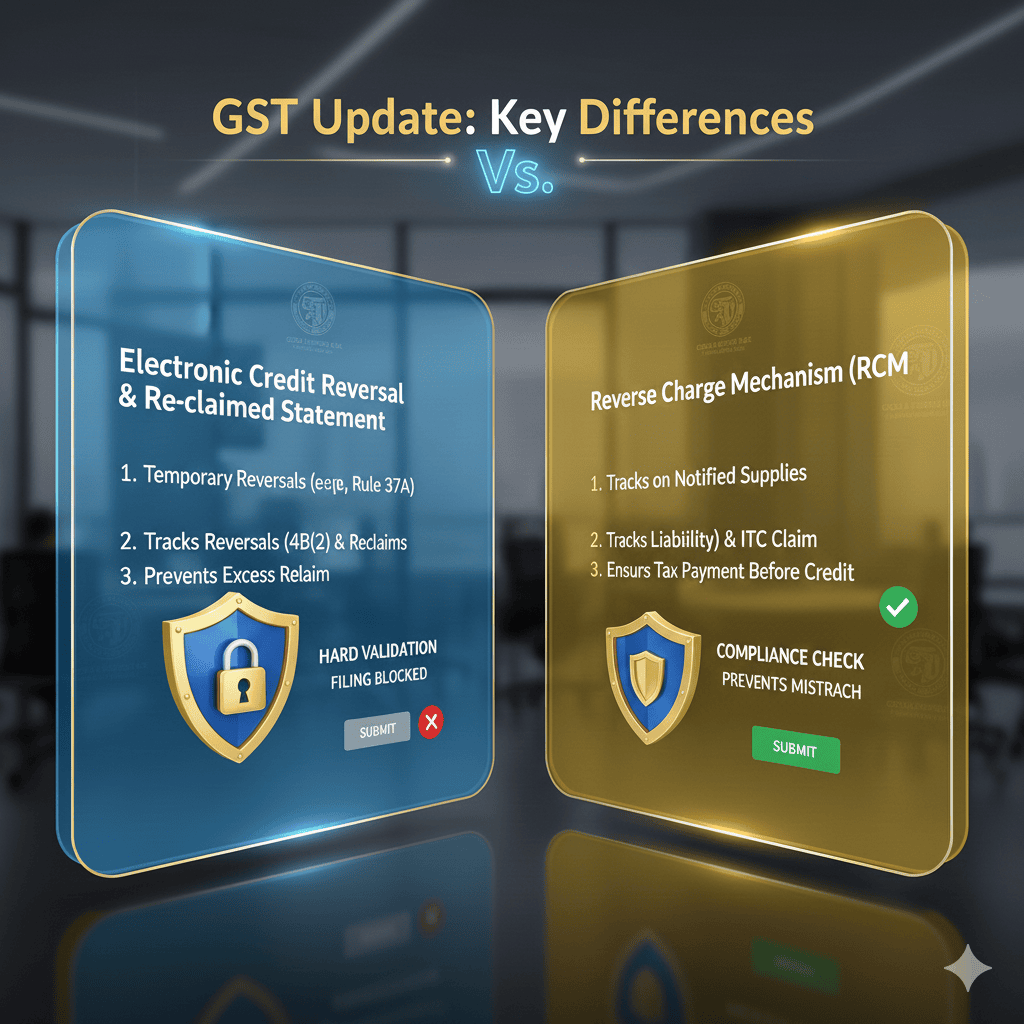
✅ What is the Electronic Credit Reversal & Re-claimed Statement?
This ledger tracks ITC that is:
🔹 Temporarily reversed in
Table 4(B)(2) – ITC Reversed (Other than Rule 42/43)
and later
🔹 Re-claimed in
Table 4(A)(5) and Table 4(D)(1)
This system is active from:
✔ August 2023 — Monthly taxpayers
✔ July–September 2023 — Quarterly taxpayers
Purpose of the Reclaim Ledger:
✔ Avoid double reclaim of ITC
✔ Maintain ITC audit trail
✔ Reduce reporting mistakes
You can view the ledger by navigating:
Dashboard ➜ Services ➜ Ledger ➜ Electronic Credit Reversal & Re-claimed
✅ What is the RCM Liability / ITC Statement?
This ledger tracks:
✔ RCM liability paid in
Table 3.1(d) — RCM Tax Payable
and
✔ ITC claimed on RCM in
Table 4A(2) & 4A(3)
This is available from:
✔ August 2024 — Monthly taxpayers
✔ July–September 2024 — Quarterly taxpayers
You can access it here:
Dashboard ➜ Services ➜ Ledger ➜ RCM Liability / ITC Statement
⚠️ Earlier — Only Warning Messages Were Shown
Earlier, if taxpayers:
❌ claimed excess ITC
❌ reclaimed ITC without sufficient reversal balance
❌ claimed more RCM ITC than liability
The portal displayed a warning message, but GSTR-3B filing was still allowed.
Now GSTN has introduced strict system validation.
🚦 New Validation Rules — Very Important
Going forward:
❌ Negative ledger balance will not be allowed
❌ Excess ITC claim will block GSTR-3B filing
🔹 Rule for Reclaim Ledger (ITC Reversal & Re-claim)
ITC reclaimed in Table 4(D)(1) must be:
👉 Less than or equal to:
✔ Closing balance in Reclaim Ledger
+
✔ ITC reversed in Table 4(B)(2) in the same return period
If reclaim exceeds allowed balance →
🚫 GSTR-3B cannot be filed
🔹 Rule for RCM Ledger
RCM ITC claimed in Table 4A(2) & 4A(3) must be:
👉 Less than or equal to:
✔ RCM liability in Table 3.1(d)
+
✔ Closing balance in RCM Ledger
If excess RCM ITC is claimed →
🚫 GSTR-3B filing will be blocked
🚫 If Ledger Balance is Already Negative — Filing Will Be Restricted
A negative balance means:
❌ excess ITC was claimed earlier
To file returns, taxpayer must:
🟡 Case 1 — Negative Balance in Reclaim Ledger
✔ Reverse excess ITC in Table 4(B)(2)
If no ITC is available:
👉 reversal amount will be added to liability
🟡 Case 2 — Negative Balance in RCM Ledger
Taxpayer must either:
✔ Pay additional RCM in Table 3.1(d)
OR
✔ Reduce RCM ITC in Table 4A(2) / 4A(3)
Only after correction →
✔ GSTR-3B filing will be allowed
🧠 Why GSTN Introduced These Ledgers?
To prevent:
❌ wrong or excess ITC reclaim
❌ double claiming of RCM ITC
❌ clerical reporting mistakes
❌ litigation & notices
To promote:
✔ transparent ITC reporting
✔ self-reconciliation
✔ stronger compliance discipline
💡 What Taxpayers Should Do Now
Businesses should start:
✔ Regularly reviewing both ledgers
✔ Reconciling ITC reversal & reclaim
✔ Matching RCM liability vs RCM ITC
✔ Avoiding reclaim without available balance
This will help avoid:
🚫 Return filing blockage
🚫 ITC recovery demands
🚫 Interest & penalties
🚫 GST department notices
🟢 Conclusion — Key Takeaway
GSTN has moved to a ledger-based ITC validation system.
From now on:
✔ ITC can be reclaimed only when reversal balance exists
✔ RCM ITC can be claimed only when liability is paid
✔ Negative balance must be corrected before filing
This ensures:
👉 accurate ITC reporting
👉 better transparency
👉 improved compliance